


globe
Large-capacity log data analysis solution

BLAS is a large-capacity data analysis system that enables rule-based real-time monitoring
and anomaly detection for data collected in large quantities of several hundred GB to several TB,
and provides ultra-high-speed search and correlation analysis between each data.
11 billion logs
Approx.
sec
Beyond simple log collection, demand for real-time analysis of TB-scale data to derive business insights is surging.
However, as data increases, system management becomes complex (such as expanding servers and relocating data),
increasing the operational burden on administrators day by day.
Based on OpenSearch, BLAS smartly classifies vast amounts of data to provide efficient and fast search and analysis results.
In addition, the system automatically handles all processes of data management without manual intervention,
and secures meaningful insights contained in data through multifaceted analysis functions.
By introducing BLAS, enterprises can not only process exploding data cost-effectively,
but also drastically reduce management resources through an automated operating environment.
Consequently, by investing time previously spent on simple management into discovering key business insights,
they build a data-driven fast and accurate decision-making framework.

Index File Management
Large-capacity Data Analysis
Data Monitoring at a Glance
Distributed Cluster Coordinating
Fast and Stable Data Search

issue
Due to digital transformation (DX), cloud migration, and the acceleration of AI adoption across all industries,
the total amount of data that companies must process is growing exponentially every year.
As a result, although the importance of data is emphasized more than ever,
selecting and analyzing meaningful business data amidst the exploding information remains a significant challenge.
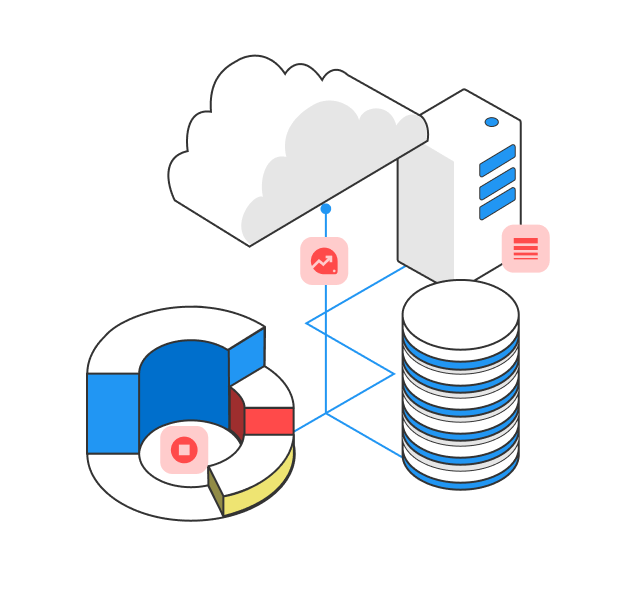
Not only is the threat of 'Shadow AI'—where confidential information is mixed into unrefined collection data and leaked—surging,
but the growth of 'Dark Data' left in management blind spots is going beyond simple cost waste to
become a critical security hole.
Although the amount of data has become abundant, it has become difficult to distinguish key signals from simple noise within tens of thousands of logs.
Consequently, operators experience 'Alert Fatigue' from frequent false positives, and face a paradoxical situation
where failure analysis and decision-making are delayed because they cannot grasp the correlation between data.
Refined architectures using Kafka, Vector DB, etc. are advanced, but Silo effects occur since data is isolated.
Operating distributed infrastructure is increasingly complex and real-time unified monitoring is impossible, reducing efficiency.
solution
BLAS automates the entire process from collection to analysis and visualization of large-capacity logs and
unstructured data through a powerful engine based on OpenSearch.
It immediately extracts core business value without performance degradation even in exploding data environments,
strongly supporting data-driven decision making.

issue
arrow_downward
solution
By transparently tracking data flows, it quickly identifies Shadow AI and leakage signs, and drastically reduces storage costs through Automated Information Lifecycle Management (ILM) based on data importance.

issue
arrow_downward
solution
By real-time filtering, it removes meaningless noise and purifies only key signals to visualize them. This helps derive meaningful patterns and insights within complex data flows, supporting fast and accurate data-driven decision making.

issue
arrow_downward
solution
With broad compatibility independent of collection methods, it integrates fragmented data into a single BLAS platform. It eliminates the inefficiencies of distributed management points and provides a proprietary integrated analysis environment covering heterogeneous data.
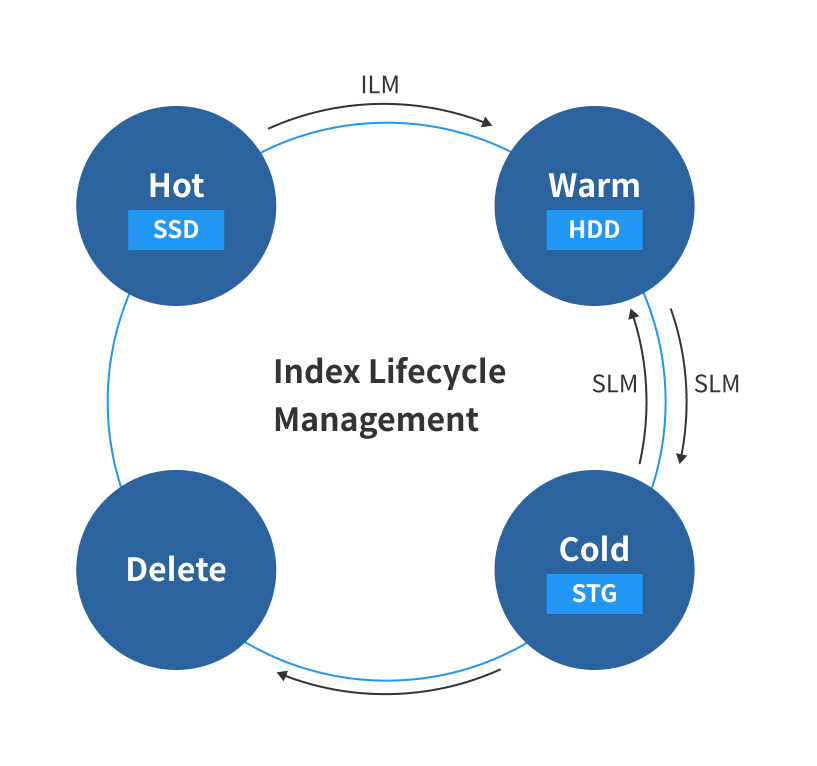
Document indexing is performed on hot nodes (SSD),
and shard files with completed daily indexing are migrated to warm nodes (HDD).
merit
Through the real-time nature of indexing as soon as data flows in,
immediate analysis is possible upon collection.
Supporting complex conditional searches beyond simple keyword matching,
it pinpoints and extracts the core data that is the root cause of failure even
among tens of thousands of logs.
function
Through data normalization, it analyzes raw data
and indexes it for fast search and analysis.
As long as there is data needed for analysis,
meaningful data analysis can be produced.
You can create widgets that track user analysis/results in real time
to monitor data on the dashboard,
providing a user-centric dashboard to check the desired information.
Configure various datasets to generate comprehensive reports
and receive regular reporting of analyzed content,
automating complex tasks to check files in PDF, Excel, Word, etc.
Based on a search engine optimized for unstructured data analysis,
it supports in-depth analysis combining complex operations
and various conditional queries (Query DSL).
By providing inflow analysis by hour and detailed statistics by source,
it allows you to identify and respond in advance
to sudden traffic changes or collection failure signs.
Expected effect
Ensure operational visibility by connecting and tracking
all activities in the system with GUID (Globally Unique Identifier).
Combine and analyze logs of different formats with a common key
to provide multidimensional analysis metrics that cross over business flows
beyond piecemeal information.
Encrypt and mask personal information to store it safely,
and strictly control access to authorized users only.
Detect security threats in real time based on all logs in the system, and integrate management of mandatory requirements such as
legal log retention periods and personal information protection regulations. Perfectly satisfying regulatory compliance requirements that
companies must observe, it blocks violation risks and secures infrastructure credibility.
Analyze bank transaction logs in real time to quickly detect abnormal financial transactions and anomalies different from usual,
and efficiently respond to security incidents by quickly investigating causes based on clear log tracking in case of occurrence.
Analyze actual driving and operation behavior patterns precisely based on system logs of precision equipment such as cars and robots,
solving exceptional situations devices face in the field, and continuously improving driving algorithms and control performance.
Analyze application user behavior logs to clearly identify bottlenecks and drop-off points in the service.
Based on objective quantitative metrics rather than speculation, it derives product improvement directions,
using customer-centric data as the basis for business decisions.
structure

Contact Us

arrow_outward
We provide various security solutions based on biometric information.

arrow_outward
We provide the optimal security measures for your company's important information.

arrow_outward
Provides data protection measures against internal data leaks.

arrow_outward
Get started with RansomSafer, our ransomware protection.

arrow_outward
The first step to securing your company's assets: AccountSafer, an AI-based embezzlement detection system.